Thursday, December 5, 2019

The Truth About Online Privacy

As I mentioned in an earlier post, when it comes to the Internet and online privacy, it is important for everyone to know that online privacy doesn't actually exist. Many of us think it exists or that our rights protect us from this, but in reality, it doesn't and companies continue to have the ability to share and sell our data with third-party groups. Over the past 25 years, the Internet forever changed our lives and changed how we and the rest of the world communicate. However, as the internet becomes more and more imperative in our daily lives, our personal privacy online starts to become less personal.


In one TEDtalk, the speaker, Juan Enriquez, compared our online personal information to tattoos. Similar to tattoos, our personal information tells a lot of stories about us. Essentially this makes our online personal information our "electronic tattoos." Because of this, our data is valuable to them as they can use this information to either sell us specific products towards our taste or sell this data to other third party companies that can do whatever they want with it. The use of facial recognition on both our faces and our cars' license plate also brings a lot of worries as this technology can be used to quickly identify the person and bring up everything from their social media accounts to their criminal records. Thanks to this technology, we have become less anonymous and because of the internet, our data will still available even after we're gone.

During my freshman year of college, I wrote an essay about the illusion of online privacy and how companies and governments use our data to either use it against us or to make a profit. In my paper, I mentioned how many Americans believe that a company's privacy policy is useful and that they are there to ensure that your private information will be protected and not used by the company. However, privacy policies actually do the opposite effect. Instead, those privacy policies are there to disclose to you what they'll do with your information and that everything they can do with it is perfectly normal and legal. Plus, companies intentionally make their privacy policies lengthy and complex because they know that most Americans don't read them anyway. One example that I gave was how Target does it. In my example, I talked about how Target, with its illusion of a helpful privacy policy, gain people's personal information and shopping history from their website only, so that Target can use it to not only recommend specific products to you but also use it to easily market it and sell your information to third party companies as well.

Sources:
https://www.ted.com/talks/juan_enriquez_your_online_life_permanent_as_a_tattoo
https://www.ted.com/talks/catherine_crump_the_small_and_surprisingly_dangerous_detail_the_police_track_about_you
http://link.galegroup.com/apps/doc/A550955416/GIC?u=hpu_main&sid=GIC&xid=4450d158 


Friday, November 29, 2019

The Reviews Are Out For Stadia: It's a Bit of a Disappointment

On November 19th, 2019, Google's new video game streaming service, Stadia, officially launched. As it released, reviews of the new streaming service came pouring out and many of them are mixed. Critics praised Stadia for achieving what was thought to be nearly impossible, streaming high-quality games seamlessly on your TV, computer, phone, and tablet. Most critics have also noted that Google Stadia is by far the best video game streaming service out there, but it still suffers from a lot of issues. While Stadia was able to stream games at a good quality, many critics noticed that a few of the games they played didn't stream at a 4K resolution and 60 fps despite having a very fast internet speed and playing on a 4K TV. This disappointed some critics as the ability to stream at that quality were a promise from Google and a big selling point for the product. Some reviewers even reported that they experienced a lot of latency issues and stutters from a game despite having good internet speed, which shows that Google is still working on the kinks of streaming games through their private servers without lag. Now, having some latency issues doesn't sound like a big deal if it's a video streaming service like Netflix, but for video games, it matters a lot especially when you are playing online with other players.

Image result for google stadia input lag gene park gif
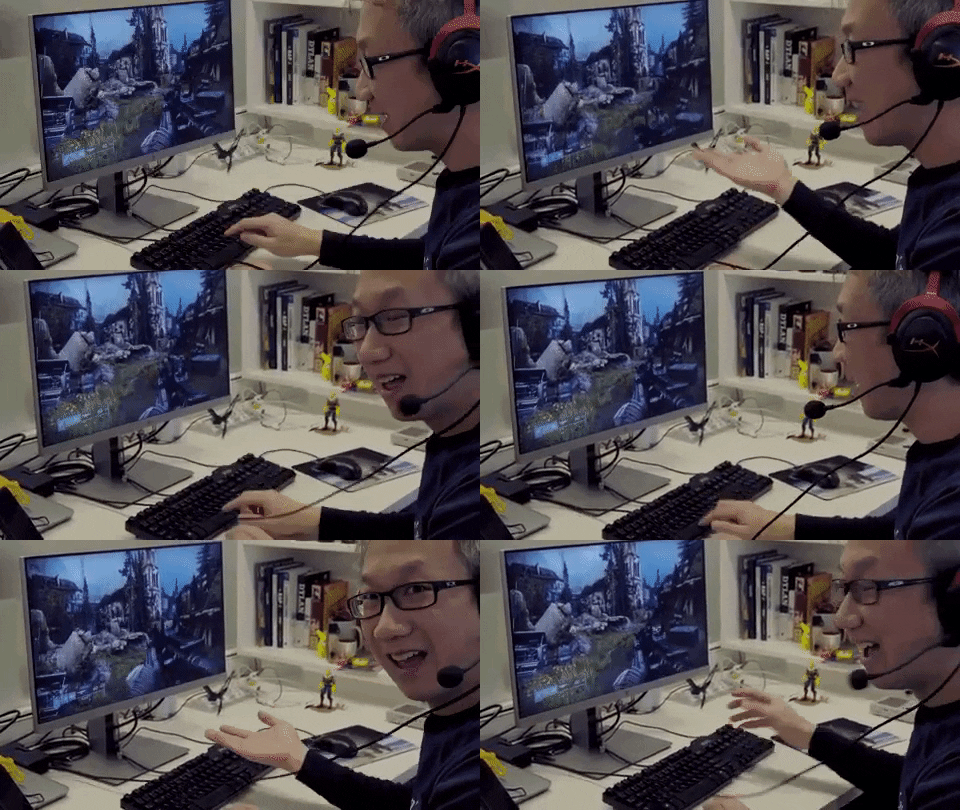
The Washington Post's, Gene Park, shows off the "horrendous" input lag he faced while playing Destiny 2 on his PC using Stadia. In this GIF, it takes about 2 seconds for his character to jump after pressing the spacebar.

Another issue that critics had with Google's Stadia was its lineup of games. Although Stadia had over 20 games available to purchase and play on its launch date, many critics were quick to take note that for a platform that's supposed to be a cheaper alternative, many of the games offered are at least over a year old and cost $60 each, which made people question what audience Google was actually marketing this towards. It didn't make sense as all these games can easily be bought for a much lower price on traditional consoles, which makes Stadia ($130) feel more expensive than it was advertised to be. Overall, Google Stadia shows a lot of potential into the future of video game streaming, but ultimately, it feels incomplete and not worth it especially if you already own a traditional game console.

In my opinion, I was always skeptical about Stadia ever since its announcement. One question that pondered over everyone's head including mine was, what audience was Google trying to market this towards? It felt like they were trying to bring "pro gamers" to transition or at least purchase their product, but it was jarring to me as their lineup had no exclusives (at launch) and only games that most gamers have most likely already played. Also, if they were trying to market this towards "casual gamers" and people who can't afford a $300 or so console, then why only add old AAA games that cost $60 each on a platform that already requires really good internet speeds to play the game at the same resolution as a console? The more questions I have about these kinds of decisions, the more I wonder about how Google thought that selling Stadia the way they did was a good idea. However, I do admit that the release of Stadia shows that the future of gaming will be streaming it, but it may be at least another decade or so to see that work flawlessly.

Sources:
https://www.gamesindustry.biz/articles/2019-11-21-google-stadia-critical-consensus
https://www.washingtonpost.com/video-games/reviews/stadia-performance-has-improved-since-launch-case-service-hasnt/
https://www.washingtonpost.com/video-games/reviews/unplayable-times-magical-others-stadias-dream-is-still-clouds/
https://www.eurogamer.net/articles/2019-11-27-google-im-not-sure-thats-how-stadia-is-supposed-to-work
https://www.forbes.com/sites/erikkain/2019/11/26/google-stadia-review-the-good-the-bad-and-the-ugly/#420fa78c6cc1

Thursday, November 21, 2019

The Illusory Truth Effect

In the communications industry, it is important to know about several communication theories to know about so that you can avoid false information at all costs. One of these theories is the Illusory Truth Effect. In its basic definition, the Illusory Truth Effect is the tendency to believe in false information to be correct after repeated exposure. This effect was first identified by Lynn Hasher, David Goldstein, and Thomas Toppino in 1977 at Villanova University and Temple University. Even though this effect was identified just a few decades ago, this theory was unknowingly used constantly throughout history.

When it comes to the Illusory Truth Effect, there's one very important thing about it that everybody should be aware of. The thing is that no matter how intelligent you think you are, everybody is prone to the illusory truth effect whether they know it or not. You can see the effects of this theory everywhere. Throughout the internet, it has been shown again and again that people always connect the truth with repetition. Some examples of the Illusory Truth Effect have commonly heard phrases such as humans can only use 10% of their brains, Vitamin C cures the common cold, and crime is at an all-time high. Despite the constant amount of times you've heard these phrases, none of them are actually true.


Related image

For years, politicians, marketers, news media, and propaganda would use this effect. Especially politicians and marketers who are known as masters for manipulating this cognitive bias. For example, if a politician were to spread false information about a rival political candidate and would repeat the ad on TV, then it can cause people to believe it. Another example of the Illusory Truth Effect can be seen from President Trump during the Mueller investigations. During the investigations, President Trump repeatedly called it a "witch hunt" and a "hoax" over a hundred times. Eventually, people would see those tweets and soon begin to believe it is a witch hunt.

In a 2012 study done at Central Washington University, researchers found that "repetition is what makes fake news work too." Another study even showed that people found a false headline to be more convincing regardless if that headline fit their political beliefs or not. So, after reading about all this you may be asking yourself, why do we mix the truth with repetition? Well, the short answer is humans, we do this to ourselves. According to an article, this effect comes from the fact that our brains find it easier to process information we've already encountered numerous times before. So if anyone is to blame, it's your brain for attempting to make it easier for you to remember things. Like I mentioned earlier, everybody is prone to it no matter what, but the best way to not be fooled by the illusory truth effect is to know that it exists. Next time, if you read something that just feels a little bit too good to be true, but you're not sure why to look into further and find out if it's true or not.

In my personal opinion, there is nothing good that comes from the illusory truth effect. All the effect does is help spread false information to millions of people most of the time. It's a theory that really doesn't have a pro, but has a lot of cons instead.\

Sources:
https://www.psychologytoday.com/us/blog/your-future-self/201911/fake-news-and-the-illusory-truth-effect
https://www.wired.com/2017/02/dont-believe-lies-just-people-repeat/

Thursday, November 14, 2019

Auditing My Online Presence

I remember when I was in the 9th grade, my high school invited a guest speaker to talk with the students about our online privacy as many of us at the time had smartphones and had somewhat of a social media presence online. The first thing he said was, "The first thing you should know about online privacy is that it doesn't exist. Many people believe that it does, but it's ultimately an illusion." This saying stuck with me, but I feel like I didn't take it too seriously back then. When I audited my online presence, I'd say that I definitely have an online presence, but I consider myself to have a small presence (hopefully). I don't own a website, but I do use multiple social media sites. The ones I still currently use are Twitter, Instagram, and Snapchat. Unlike many people I know, I've never had a Facebook account. This is mainly because since I was 13, my parents were against me being on Facebook, but were okay with me using other social media accounts.

Image result for digital footprint

On Instagram, my account is set to private so only my followers, who are mostly friends and family, can see what I post. I usually post things in my personal life that I find exciting and want to share with others, but I make sure that it is appropriate and try to keep my profile professional. However, I rarely post on Instagram as my last post on my account was posted more than a year ago.

On Twitter, my account is public, but I don't use my real name or show my birthday. I very rarely tweet about anything and I often retweet other tweets. These retweets are mainly tweets that contain news on current events, news throughout the gaming industry, and any tweets that I find funny.

On Snapchat, I often use my account to connect with friends and family by sending snaps. I also use it as my main messaging place for most of my friends. I often message my friends and I'll sometimes share snaps on my story if I think it is worth sharing with everyone that has added me.

By viewing my social media accounts, someone could learn that I am passionate about video games, movies, and that I like to stay updated on current events going on around the world. They'll also possibly learn that I like to post pictures of my travels as well as celebrations.

Besides my social media accounts, I have also given out my phone number and email to other sites. This information is often required by many other sites if you want to create an account, especially when it comes to playing video games. For all video game platforms (Xbox, Playstation, Steam, Nintendo), you need to provide an email account if you want to create an account to play online with others or to purchase games digitally. Even some gaming companies like EA require you to have an EA account to access online multiplayer features for their games.

Wednesday, November 13, 2019

Rogers' Diffusion of Innovations (or Ideas): YouTube

Before 2005, there weren't really any websites that allowed people to share videos with others via the Internet. Back then, you'd have to watch videos that were uploaded on specific websites. It wasn't until three Paypal employees, Steve Chen, Chad Hurley, and Jawed Karim were inspired to create a website that would make it easy to share videos with others after a dinner party in San Fransisco in 2004 where the trio complained how there was no simple way to watch and share video clips online. On Valentine's day in 2005, these three would found YouTube, a website that would become the biggest video-distribution platform on the Internet, generate billions of dollars annually, and be visited by billions of people around the world. It would also become a foundation for the rise of Internet celebrities, people who would become widely popular from the videos they post online. Using the model depicting Roger's Diffusion of Innovations theory, I will present a few major events that I believe are significant in how YouTube greatly impacted our lives and changed how we share videos online.

In 2005, two major events happened in YouTube's history after it launched earlier that year. While in beta, on April 23rd, 2005, one of the founders, Jawed Karim, would upload the first video on YouTube called, "Me at the Zoo." The video was a short, 19-second clip of Jawed Karim talking about elephants and their trunks at a zoo in San Diego. The other major event that happened in 2005 occurred in Septemeber, where a video on YouTube became the first video to garner one-million views as well as becoming YouTube's first viral video. The first viral YouTube video was a Nike ad, where a soccer player, Ronaldinho, received a pair of golden boots. Later on, Nike would also be one of the first major companies that adopted YouTube and saw it as a new platform to promote future products to consumers. By the end of 2005, YouTube would exit out of beta and publicly launch for the rest of the world to use.

In 2006, two other major events occurred that would be the beginning of the YouTube we know today. In February 2006, a clip from NBC's show, Saturday Night Live, went viral and brought more attention to the site. However, NBC wasn't happy about people posting these clips on the site and asked YouTube to take them down, which they did. Although in June 2006, YouTube would make a deal with NBC and would then promote their TV lineup. This deal would be the start to bring other traditional media companies into the digital era and form important partnerships. YouTube would also, later on, launch the Content Verification Program in October, which would help content owners like NBC remove videos that would violate copyright laws. The other major event that happened in late 2006 was Google buying YouTube for about $1.65 billion and called it, "the next step in the evolution of the Internet."

In 2007, multiple events happened that would allow YouTube to take off and gain the late majority. In May 2007, YouTube would introduce the Partner Program, a program that would allow 'YouTubers' to monetize their videos and earn money from it. This specific decision from the company would allow their users to finally turn their hobbies into careers and businesses. One example of someone who benefitted from this program was Michael Buckley. According to a New York Times article, Michael Buckley, creator of the "What the Buck Show," he earned more money from his videos than he did from his day job's salary as an assistant for a music company. The article also went on to report as well that the most successful users on the site earned around six-figure incomes from their videos around 2007-2008. In July 2007, YouTube would then partner with CNN to host the presidential debate for the 2008 election. YouTube would allow its users to submit video questions, which CNN would then show those videos to the presidential candidates and they would have to answer them on live TV. This was an extremely ambitious idea for the time, and it would become the first time in history where videos generated by online users would drive the debate.

At this point in time, I consider 2009 to be the tipping point for YouTube in its history. In 2009, YouTube would become more mainstream and garner a bigger audience as the United States Congress would launch multiple official YouTube channels. Even the Vatican launched its own YouTube channel soon after. This decision would help Americans attain a new level of access that could've never been done before without YouTube and the Internet. The music company, Vivendi also teamed up with YouTube to launch Vevo, a music video service that would be able to exclusively post music videos themselves onto YouTube via official Vevo channels.

I consider the time between 2011-2013 to be the years where late adopters started to use YouTube. Most of these late adopters were mostly users from the rest of the world as more and more countries got access to YouTube as well as getting it localized in their language (as of 2019, YouTube is available in 91 countries). In 2011, YouTube was one of the few online platforms that played a huge role in spreading messages of freedom and democracy to the rest of the world. During the start of the Arab Spring, activists used platforms like YouTube to post videos of protests to help bring awareness to the movement. These videos would become viral. In 2012, people all over the world were able to watch a live-stream of the summer Olympics through YouTube for the first time ever, and YouTube would also become the "go-to" place for the 2012 presidential election as it would live stream speeches and provide coverage over the election via YouTube's Elections Hub. Also in 2012, YouTube would hit another milestone as a K-Pop (Korean Pop) star, PSY, would become a worldwide phenomenon as his music video, "Gangnam Style," would be the first to gain 1-billion views in less than 5 months.

Then there are the laggards, which I believe like goes from 2016-2019. During this time, YouTube had expanded to more than just a video-sharing site. Today, you're able to watch videos, movies, live streams, and tv shows. YouTube, like many other popular entertainment sites, also has a subscription service called YouTube Premium, where it allows you to watch any video ad-free and also gives you exclusive access to original shows and movies, some of them starring popular YouTubers. Despite many of YouTube's success and huge impacts across the Internet and the world as a whole, it also brought issues. In the past few years, YouTube has been criticized for multiple operations that they handle including, its decision over copyrighted material in uploaded videos, its recommendations algorithm that's been found to help spread and promote conspiracy videos and "fake news," hosting videos targeted towards children than include violent or sexually suggestive content involving popular characters, and ad policies that constantly change to determine what can be monetized with advertising. Despite all this, YouTube is now 2nd most visited website of all time and it still rakes in billions of dollars of revenue for Google.

Sources:
https://www.businessinsider.com/key-turning-points-history-of-youtube-2013-2#in-a-little-over-5-months-gangnam-style-hit-1-billion-views-in-december-2012-22
https://www.nytimes.com/2008/12/11/business/media/11youtube.html
https://interestingengineering.com/youtube-its-history-and-impact-on-the-internet
https://www.polygon.com/2018/5/10/17268102/youtube-demonetization-pewdiepie-logan-paul-casey-neistat-philip-defranco

Tuesday, October 29, 2019

The Watchdog Rule

The idea to check on government power (aka The Watchdog Rule), is one of eight values of free expression. This idea basically says that freedom of the press enables citizens to learn about abuses of power and then do something about the abuse at the ballot box if they feel so moved. Every citizen, including the press, is part of the check-and-balance system so that we can restrain government power and abuse of power if need be. There are multiple examples of the use of the Watchdog Rule throughout the past 50 years in American history. One of these examples is Irangate, better known as the Iran-Contra affair.

The Iran-Contra affair or "Irangate", was a secret arms deal where the U.S. government traded weapons like missiles and guns to Lebanese terrorists. These terrorists held American hostages and the U.S. would sell them arms to free them. However, these funds used for the secret deal would also be used to support an anti-Communist rebel group in Nicaragua, known as the Contra's.

Image result for iran contra affair

In 1980, President Ronald Reagan won the White House and promised his supporters during his campaign that he would assist any and all anti-Communist insurgencies around the world, which was known as the Reagan Doctrine. Unfortunately for President Reagan, the Republican Party lost the majority in both the Senate and the House of Representatives during the mid-term elections in 1982. When the Democrats took over Congress, they would pass the Boland Amendment, which restricted the CIA and Department of Defense to involve itself in foreign conflicts. The Boland Amendment actually specifically targeted the conflict in Nicaragua during that time, as the Sandanista government was fighting the Contras, an anti-Communist rebel group that earned the majority of their funds through the drug trade. Despite this new law, President Reagan ordered his National Security Advisor, Robert MacFarlane, to discover a way to help the Contras regardless of the consequences.

Around the time President Reagan started secretly assisting the Contras, Reagan was also dealing with a dire situation in the Middle East. Sometime during 1985, Iran-backed terrorists in Lebanon had taken several American hostages and President Reagan would respond by negotiating with Iran. Robert MacFarlane told Reagan that Iran was interested in buying weapons from the US to help them fight against Iraq, even though there was currently a U.S. trade embargo on Iran. Despite that, President Reagan would agree to an arms deal and take some of the funds earned from it to arm the Contras in the process as well.

The public would not learn of this arms deal until 1986, where a Lebanese newspaper called, Al-Shiraa, reported about the secret arms deal between the U.S. and Iran. The press in America would report about this scandal for the rest of Ronald Reagan's presidency. In the end, around 14 people, including MacFarlane, were charged and served time in prison. Despite being one of the biggest political scandals in the 20th century, this scandal is often overlooked and unlike the other scandals, Ronald Reagan would be forgiven by most of the public.

This is just one of the few examples of the Watchdog Rule being used by the American press to enlighten citizens and hopefully prevent any further abuse of power from the branches of government. Citizens have a role in the checks-and-balances system, and it is to ensure that our government doesn't cross the line.

Source: https://www.history.com/topics/1980s/iran-contra-affair


Wednesday, October 9, 2019

The Interesting History of the Internet

The Internet that we know today contains hundreds of thousands of websites and endless information on basically anything. Today, the Internet has social media sites, informational sites, news sites, video game sites, shopping sites, and plenty more. However, the Internet wasn't like this when it was first created. Many people believe the Internet didn't exist until it was given to the public in the 90s and then the World Wide Web was soon introduced around '95. In reality, the Internet was actually created in the 1960s and it had a different purpose.

During the 1960s, tensions between the U.S. and the U.S.S.R. were at the highest it's been during the Cold War. Events such as the Cuban Missile Crisis and the Space Race are well-known events that happened during the 60s. In the early 1960s, MIT's J.C.R. Licklider, an American psychologist & computer scientist, proposed an idea of a "Galactic Network" of computers. He believed that this idea could act as an alternative way of communication between government leaders if the Soviets decided to destroy the telephone system. By the late 60s, the first workable prototype of the Internet would be invented with the creation of ARPAnet (Advanced Research Projects Agency Network), which were both funded by the U.S. Department of Defense.

Picture of ARPAnet in the 1970s

In 1969, ARPAnet, the government's computer network, would send the first message from a computer at UCLA to another computer located at Stanford. At the time, computers were so big that they would take up as much space as a small house would. The first message became a spectacular failure. The message sent was the word, "LOGIN", but ARPAnet's servers crashed and the Stanford computer would only receive the first two letters of the word.

In 1983, ARPAnet would then adopt TCP/IP or the Transmission Control Protocol/Internet Protocol, which was invented by a computer scientist, Vinton Cerf. This invention would help form the "network of networks", which would become an integral part of the Internet. The TCP/IP was best described as a "virtual handshake" that would help introduce one computer to the other.

The Internet would only be used for government communications until 1990, where a computer scientist and engineer named Tim-Berners Lee would use the Internet as the foundation of the World Wide Web. This is what we know as the Internet today. By 1992, the Internet would then be open to the public and used for commercial purposes. This decision would change the lives of millions of people for almost the next three decades.

Today, 4.3 billion people around the world use the Internet on almost a daily basis. It is crazy to think about how this type of technology has forever changed the lives of billions of people in just fifty years. It's amazing to see how the Internet once was seen as an obscure research idea to a revolutionary technology that is imperative to have within the digital world of the 21st century.

Sources:
https://www.history.com/topics/inventions/invention-of-the-internet
https://www.history.com/news/who-invented-the-internet

Communication in the 21st Century

Communication has evolved greatly in the past 20 years. Back in 1999, cell phones were only used to call one another and the public Internet was still in its early stages. Thanks to better technology and innovation, smartphones have become an integral part of our daily lives as well as the Internet. These types of technology have been able to keep us connected to billions of people all over the world. The smartphone especially has allowed us to do hundreds of other things rather than just calling somebody. Smartphones allow you to text messages to people, use the Internet, order food, play games, and so much more! However, in the past few years, people, particularly young people, are spending much more of their day on their phones rather than interacting with people face-to-face or spending time with others. Ever since the first smartphone was released, more and more people would rather text than call people. We are so easily connected to everybody that it's easier to call them or text them rather than visit them in person. In a way, we are both connected and disconnected at the same time. In these times, we as the generation who grew up with this technology must learn how to balance our tech usage in our daily lives. I don't believe that people shouldn't stop using smartphones, but I believe that it's necessary for us to know when we've spent too much time on them. Overall, we as a society need to find a balance between socializing and spending time on our phones so that we don't go towards a path of always being digitally connected but socially disconnected as well.


https://youtu.be/5DU1B_XkyIk

Wednesday, September 25, 2019

Antiwar & The American Conservative

A screenshot of the main page from Antiwar.com


The political news website, Antiwar.com, considers itself as the, "best source for antiwar news, viewpoints, and activities." On their About Us page, they state that their news site is ready by various people across the political spectrum including, "libertarians, pacifists, leftists, greens, and independents alike, as well as many on the Right who agree with our opposition to imperialism." Judging by the site's homepage, many of the articles shown there are mainly on the topic of war, the U.S. Government, and anything else that's going on around the rest of the world that involves the United States. While some of the articles are written and published on the website, many of the articles shown on their homepage hyperlink to articles posted on other political news sites such as The Hill, LobeLog, and MSNBC.

https://www.antiwar.com/

A screenshot of the main page from The American Conservative


The other political news website, The American Conservative, seem to write about a variety of topics such as politics, world news, culture, events, and new urbanism. Unlike the other site, The American Conservative seems to have journalists or writers who write most of their own articles and publish them onto their site. Plus, the website seems to aim for an audience that shares their Conservative values and beliefs. The news site also prints and sell magazines to those who subscribe to them.

https://www.theamericanconservative.com/

Wednesday, September 18, 2019

Facebook's Loophole Problem

After the 2016 presidential election, the social media site, Facebook, had been under fire for showing advertisements and the such that were eventually linked and proven to intentionally spread misinformation to users. Russia had been accused of buying up ad space and creating fake bot accounts to further spread misinformation and propaganda to 1.5 billion Facebook users. Since then, Facebook had promised to fight back against fake news on its website by removing the fake accounts and updating their policy to ensure that fake news couldn't be spread off the platform. Facebook has done a good job taking care of this issue, but it's still far from over. Recently, a glitch has been discovered on the site where users can edit a link preview of an article that you can share. The ability to edit a link preview allows you to edit the image, headline, and description of the article into whatever you want.
This image shows an article that has been shared on Facebook.
This image shows the same article except its headline has been changed with the glitch.


However, this glitch can only be done in Facebook Groups. Apparently, Facebook had already removed the ability to edit link previews in 2017, due to it being abused by people to spread fake news. As of September 9th, 2019, the glitch has not been fixed and people in a Facebook Group can still edit link previews.

https://mashable.com/article/facebook-loophole-fake-news-link-preview/

Wednesday, September 11, 2019

The Brief History and Workings of the U.S. Supreme Court


The United States Supreme Court is one of the three branches of the U.S. Government and is known as the highest judicial court in the United States of America. The Supreme Court is considered by many to be the most powerful judicial system in the country and possibly the most powerful in the whole wide world. However, the Supreme Court was not always like this.

In 1789, Congress passed the Judiciary Act of 1789, which officially established the judicial branch of the United States Government. In 1801, the Supreme Court moved to the nation's Capitol building in D.C. At the time, no one wanted to be in the judicial branch because the Supreme Court was considered a joke back then. When John Marshall was appointed as Chief Justice in 1801, he planned to elevate the power of the Supreme Court. Soon after, John Marshall and the court established the power of judicial review, which allowed them to dictate what things like regulations and treaties violate the U.S. Constitution. This change made the powers of each branch of government more balanced than before.

Today, there are now nine justices on the court instead of six like it was when it first began. The nine justices have the power to strike down a President's executive action, the power of judicial review, and have the highest jurisdiction over any cases on the state level and federal level. The only way to join the Supreme Court is for the President of the United States to appoint them. Surprisingly, there have only been about one hundred justices on the court in all of American history, as most of these members will stay on the court for about sixteen years or more. The Supreme Court receives almost 7,000 cases every year from people who appealed the lower courts ruling on a case. Due to the sheer amount of cases they receive every year, the Supreme Court can't accept all of them and will have to only allow to look over 100 cases a year.

https://www.youtube.com/watch?v=cWRoXYRsaeo&feature=youtu.be

Wednesday, September 4, 2019

Google Stadia: A New Streaming Service For Video Games

With just a few months away from release, I thought it would be interesting to mention about Google Stadia, Google's new cloud streaming service for video games that may start a new era in the video game industry. As someone who is majoring in Game & Interactive Media Design and who has been an avid gamer for most of my life, I regularly check on recent news happening in the industry and Google's new streaming platform is very intriguing.


The basic idea of Google Stadia is that rather than paying for an expensive gaming console to play video games, you can instead stream video games at very high quality on either your smartphone, tablet, computer, or TV screen. In a way, Google Stadia is like Netflix for games. Currently, Google will be releasing Stadia in November for about $130, but sometime in 2020, they expect to make Stadia free with a subscription service as well. However, many people in the gaming community (including myself) worry that the biggest concern for Stadia is solving the latency issue so that games don't buffer when you play them. If Stadia does become a success, it could change how we play games in the future.

https://www.cnbc.com/2019/08/21/googles-giant-leap-into-video-game-streaming.html

Sunday, September 1, 2019

About Myself

My name is Christopher O'Brien, but many of my friends and family usually call me "CJ" instead. I am currently a sophomore at High Point University, and I'm majoring in Game & Interactive Media Design while also considering minoring in Computer Science as well. For now, I intend to graduate at HPU and hope to land a job in the growing video game industry as a game designer in the future. I enjoy hanging out with friends, watching movies, and, of course, playing video games!

The Truth About Online Privacy

As I mentioned in an earlier post, when it comes to the Internet and online privacy, it is important for everyone to know that online privac...